One of the most enduring and controversial questions in the realm of finance is whether it is better to apply any available extra funds towards aggressively paying off a mortgage versus allocating them to investments such as the S&P 500. The answer to this question is not always simple and is very dependent upon individual circumstances.
Let’s analyze arguments for each approach to help you make a decision.
The Argument for Paying Off Your Mortgage Early
Indeed, for many people, the attraction of having a debt-free property may be very strong. There are many good reasons why it may make sense for you to speed up your mortgage repayments:
1. Guaranteed Return (Risk-Free Savings)
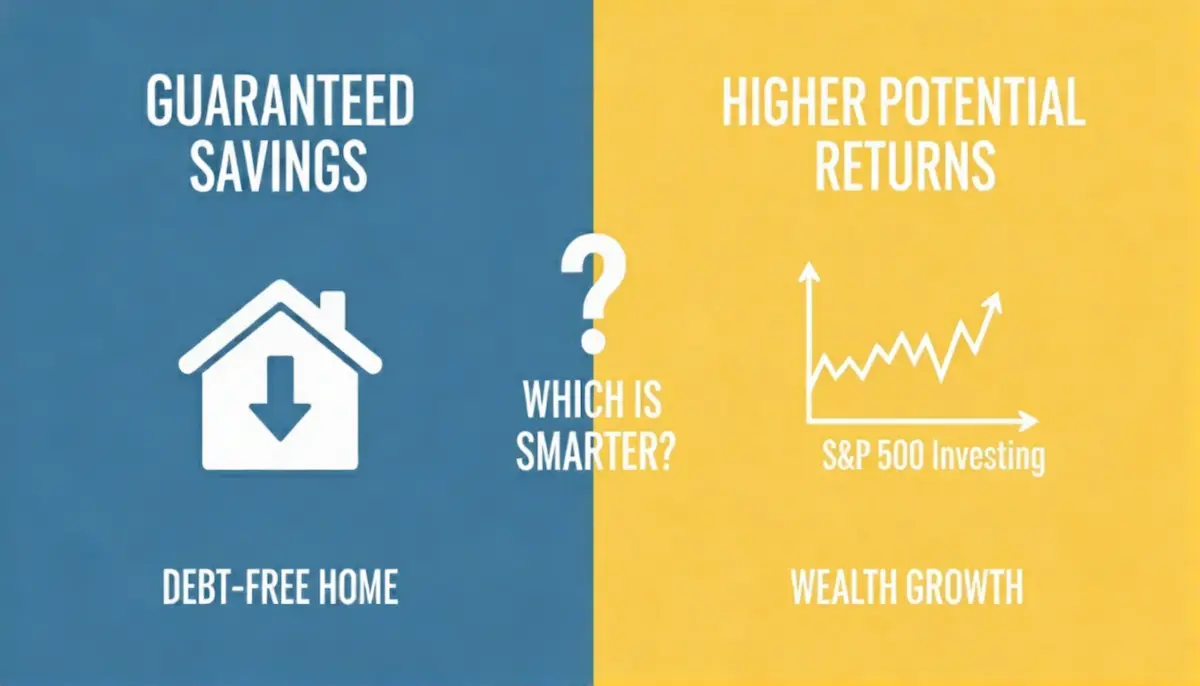
When you repay your mortgage prematurely, you are effectively making an annual return of 4%, which is equal to your mortgage rate of interest. For example, if you are paying for a mortgage at an annual rate of 4%, each dollar you repay saves you an amount of interest equal to 4%.
2. Peace of Mind
There is irrefutable psychological value that comes with owning a home that does not require a monthly mortgage payment. Feeling debt-free on your most valuable asset will do a lot for your stress levels and give you peace of mind.
3. Lower Financial Risk
By eliminating your mortgage payment, you save a large part of your budget. If you lose your job, become sick, or face difficult economic conditions, your cost of living is significantly lowered.
4. Boosted Cash Flow
"After the mortgage payment is eliminated, that cash can then be allocated towards other savings goals—perhaps a retirement fund, a college savings plan, a vacation fund, or even an investment portfolio that can be more speculative because there will no longer be a housing payment that must be made."
The Rationale for Investing in the S&P 500
The S&P 500 is an index fund that targets the performance of 500 of the largest companies in the United States. Historically, it has offered excellent returns and is a sound choice for investors wishing to pursue growth.
1. Higher Potential Returns
Historically, the average return on the S&P 500 has been around 10 to 12% annually (pre-inflation returns). When this is contrasted with the typical rate of return on a home mortgage of 3 to 6%, it appears that the return on the S&P 500 has greater potential.
2. Inflation Hedge
With time, inflation reduces the value of money. Though your mortgage payment will remain constant (assuming a constant rate mortgage), its value reduces as a result of inflation. Investments in stocks, such as S&P 500 investments, generally beat inflation.
3. Liquidity
A consequence of investing in the S&P 500 (say, through a brokerage account) is that it is easier to access cash compared with money tied up in your home. Though you shouldn't tap investment accounts for immediate spending, during an emergency, it is easier to sell investment holdings compared with accessing cash from your home.
4. Tax Advantages
When you invest funds using tax-advantaged mechanisms such as a 401(k) plan or an IRA, you enjoy substantial tax advantages (tax-deferred gains or tax-free withdrawals during retirement). On the other hand, you enjoy decreasing returns with respect to mortgage interest, which is sometimes deductible.
Key Factors to Consider
Your Mortgage Interest Rate
-
High Interest Mortgage (e.g., > 5%): Early repayment could be a better strategy, where the assured gain of principal repayment exceeds the long-term average return of the S&P 500 index.
-
Low-Interest Mortgage (e.g., < 4%): An investment may prove attractive since the market rate of return could potentially be higher than the rate on your loan.
Your Risk Tolerance
- Risk-Averse: Ifvolatile market conditions give you trouble sleeping, a guaranteed return and the comfort that comes with early mortgage payoff may suit you better.
- **Comfortable with Risk**: If you have a long time horizon and can stomach market fluctuations, feeling comfortable with risk and investing for potentially higher returns might be your route.
Your Overall Financial Picture
-
High-Interest Debt: First, always consider paying off high-interest-debt instruments such as credit cards and personal loans before considering either alternative above.
-
Emergency Fund: Always save enough money for an emergency fund (3-6 months of expenses) before allocating money towards other goals.
-
Retirement Savings: Are you contributing the maximum amount to your 401(k) or IRA, especially to take advantage of an employer match? That is "free money" you are forgoing.
The Hybrid Approach
But you don't have to pick either/or. Many personal finance advisors recommend doing both:
-
Take advantage of your 401(k) company match. It is free
-
Create a strong emergency fund.
-
Split the difference. Put some of your extra money toward paying off your mortgage aggressively and invest in the S&P 500.
-
Re-evaluate regularly. Changes in your financial profile and market trends may warrant switching to an alternate strategy.
Conclusion
It is ultimately a personal decision whether you should pay off your mortgage early or invest your money into the S&P 500. There is no right answer here either. You will be able to make the right decision for you after you understand the benefits of each decision and what your current financial situation is.
Need to calculate your potential savings on your mortgage payment? Try our Free Mortgage Payoff Calculator today to save money on your mortgage payment costs!